Using Fall Wheat Growth Stages for Better Timing
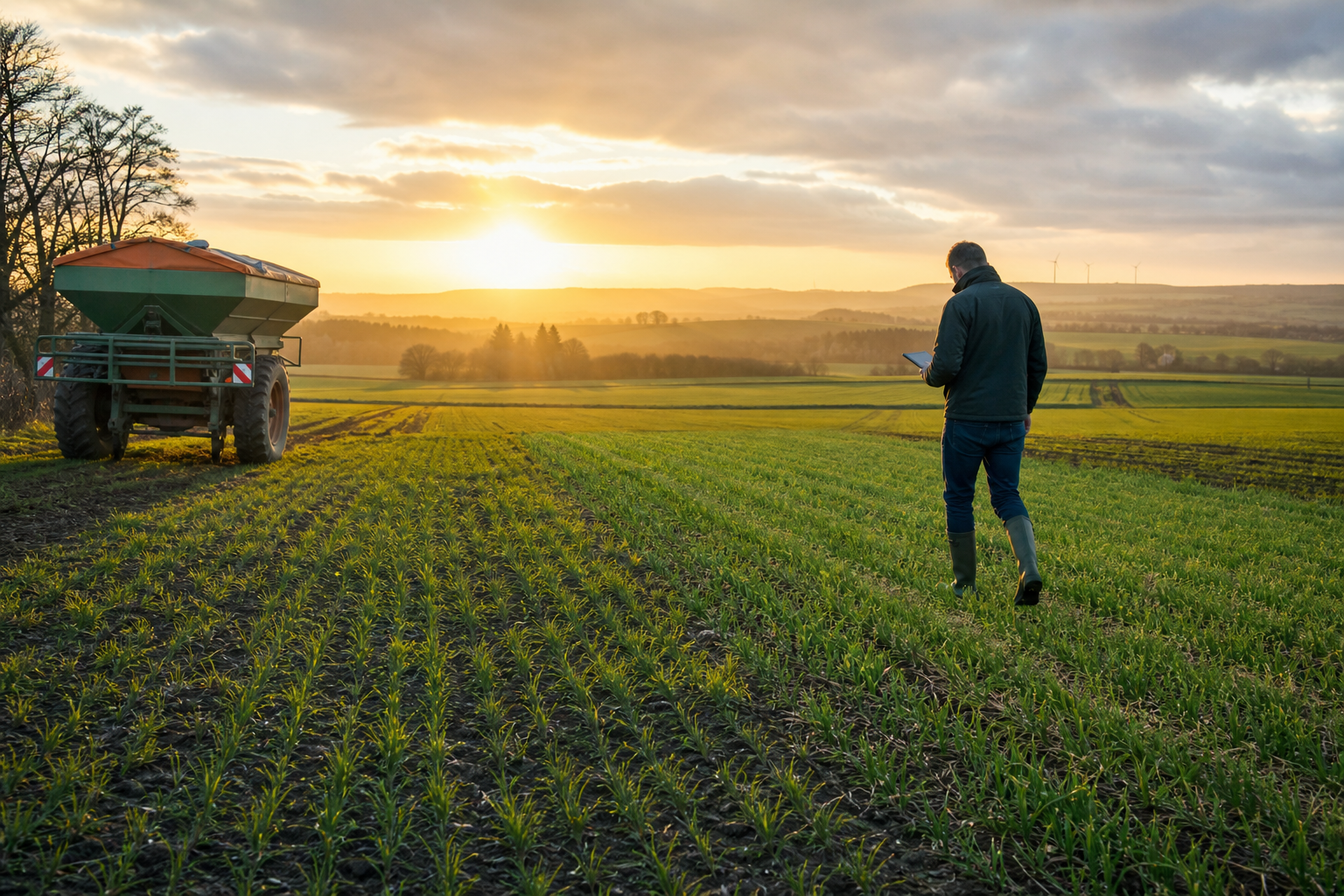
Why fall wheat growth stages matter for in-season decisions
In wheat, timing is usually more valuable than intensity. A perfectly chosen nitrogen rate can still underperform if it is applied too early, too late, or under the wrong field conditions. The same is true for disease scouting. If you walk fields on a calendar schedule instead of by crop stage, you can miss the disease window that matters most for yield protection.
That is why understanding fall wheat growth stages is so useful. Growth stages give you a field-ready framework for deciding when to topdress nitrogen, when to intensify scouting, and when to hold off. They also help you prioritize fields, since wheat rarely develops uniformly across every planting date, soil type, or drainage zone.
For small to mid-size farms, stage-based management creates a practical bridge between agronomy and day-to-day operations. Instead of asking, “Should we apply this week?” you ask, “Which fields are at the right stage, with the right weather, and the right yield potential?” That is a much better question.
Tools that combine field mapping, crop tracking, live weather, and financial analytics make that process easier because you can compare stage, field history, and application timing in one place rather than relying on memory or scattered notes.
Know the key fall wheat growth stages that drive management
Not every growth stage carries the same management weight. For nitrogen topdress and disease scouting, a few stages matter more than others.
Emergence and early seedling growth
After emergence, focus on stand establishment, uniformity, crusting, ponding, insect feeding, and fall weed pressure. This is less about immediate topdress decisions and more about confirming whether the crop has the stand and vigor to justify stronger spring inputs later.
Tillering
Tillering is one of the most important stages in wheat management. During this period, the plant develops side shoots that can become grain-bearing stems. Fall tiller development often influences spring yield potential, especially where planting date, seeding depth, and fall fertility affect early vigor.
At this stage, scout for:
- Stand gaps and uneven emergence
- Compaction or drainage issues
- Early foliar disease symptoms in susceptible fields
- Differences between management zones or soil types
If fall growth is weak, note those fields for closer spring evaluation before investing heavily in nitrogen. If stands are strong and tillering is active, those fields often deserve earlier attention once topdress conditions line up.
Winter dormancy and green-up
Once the crop exits winter, green-up is your transition point from observation to active fertility planning. This is where field-by-field assessment matters. Winter injury, saturated soils, and lost tillers can change the return on nitrogen dramatically.
Before topdress, compare each field’s stand, tiller counts, drainage, and yield history. If you already use zone-based planning, this is also a good time to revisit prior soil fertility work. A strong preseason nutrient strategy often starts long before topdress season. For related planning ideas, see Use Fall Soil Sampling to Build a Better Fertilizer Plan.
Feekes 5 to 6: leaf sheath erection to first node
This period is often the most critical for nitrogen timing decisions. In many systems, the best topdress window falls from late tillering into early stem elongation, depending on environment, soil supply, and risk of loss. Applying before the crop can use it raises the chance of leaching, denitrification, or inefficient uptake. Waiting too long can limit tiller retention and yield potential.
Jointing and first node appearance also raise the importance of disease scouting, because canopy density, humidity, and warmer conditions can increase risk in some regions.
How to time nitrogen topdress using wheat growth stages
There is no single perfect date for wheat nitrogen topdress. The right timing depends on growth stage, field conditions, weather outlook, and realistic yield potential. Still, growth stages help narrow the window.
Match nitrogen timing to crop uptake, not just calendar timing
Wheat nitrogen demand rises as the crop moves from tillering into stem elongation. Applying in that period typically improves the chance that nitrogen is present when the plant can use it efficiently. In contrast, very early applications can sit exposed to weather losses, especially on wet soils or where warm conditions stimulate loss before uptake ramps up.
As a rule of thumb, target topdress when:
- The crop has a viable stand and enough tillers to support yield goals
- Fields are trafficable with minimal compaction risk
- Rainfall is likely to move nitrogen into the root zone without creating major loss conditions
- The crop is moving from late tillering toward early stem elongation
This is where live weather monitoring adds real value. A forecast of steady, moderate rainfall may support application, while heavy rain on saturated soils should make you cautious. Reliable outlooks from sources such as https://www.noaa.gov can support those field-level decisions.
Adjust by field variability
Not all fields should be treated the same. Earlier-planted wheat may be further advanced and ready first. Low-lying or poorly drained fields may be at higher risk of N loss. Sandier areas may need tighter timing than heavier soils. If one field has thin stands from winter injury, a full-yield nitrogen plan may no longer pencil out.
That is why mapped field records are so useful. With clear stage notes and boundaries, you can decide where to send the spreader first and where to wait. If you are already building field-level workflows, How to Use Crop Growth Stage Maps to Plan Fieldwork offers a helpful framework.
Use economics, not habit
Nitrogen timing should also reflect expected return. Strong wheat prices and high yield potential may justify timely passes even in a tight labor window. Weaker stands or lower market incentives may call for a more conservative plan. That is where farm financial tracking matters. Looking at input costs, expected response, and field performance together helps prevent “routine” applications that do not pay.
The best nitrogen pass is not always the earliest pass. It is the one made when crop stage, soil conditions, and yield potential all support a return.
How fall wheat growth stages improve disease scouting
Disease scouting becomes more effective when tied to growth stage because susceptibility and economic risk change as the canopy develops. A field with low disease pressure at early tillering can still become a concern quickly once denser growth, dew, and warmer temperatures create a favorable environment.
Start with the highest-risk fields
Prioritize fields with:
- Susceptible varieties
- Continuous wheat or tight wheat rotations
- Heavy residue
- Dense canopies and high fertility
- History of foliar disease problems
- Low air movement or moisture-prone topography
These fields deserve earlier and more frequent checks as growth advances.
What to scout at each stage
Early tillering: Look for stand variability, winter annual weeds, insect injury, and the first signs of foliar disease. At this stage, the goal is early detection and identifying patterns, not rushing every field into treatment.
Late tillering to jointing: Increase scouting intensity. Check lower leaves, canopy humidity, and disease spread pattern. Ask whether symptoms are isolated, fieldwide, or tied to drainage or residue zones.
Stem elongation onward: Continue to monitor disease progression and overall crop stress. Once the crop is moving quickly, intervals between scouting passes often need to shorten, particularly during humid weather.
Land-grant extension programs are excellent references for disease identification and local thresholds. Good starting points include https://extension.umn.edu and https://crops.extension.iastate.edu.
Record what you see, not just whether you scouted
Many scouting programs break down because the notes are too vague to guide action. “Field looked good” does not help much two weeks later. Better records include:
- Growth stage at time of scouting
- Field area affected
- Severity and pattern of symptoms
- Recent weather conditions
- Photos from consistent locations
- Recommended follow-up date
If your team scouts multiple fields, digital records reduce missed handoffs and help everyone see what changed since the last visit. For more on structured scouting workflows, read How to Use a Crop Scouting App to Catch Pests Early.
Build a practical topdress and scouting workflow
A strong wheat program does not need to be complicated, but it should be repeatable. A stage-based workflow keeps decisions grounded in agronomy while staying realistic for a busy operation.
- Map every wheat field clearly. Separate fields by planting date, variety, and known problem areas.
- Track growth stage weekly during key periods. Especially from green-up through early stem elongation.
- Rank fields by topdress priority. Start with healthy stands at the right stage and with the best yield potential.
- Overlay weather risk. Avoid applications just ahead of major runoff or saturated conditions when possible.
- Scout before and after nitrogen. Document crop response and watch for disease in thick, fast-growing canopies.
- Review economics by field. Compare yield response, input timing, and margin after harvest.
This kind of system is exactly where farm management software can save time. Instead of juggling spreadsheets, text messages, and notebook entries, you can centralize field stages, weather, scouting observations, and financial performance. CropSense is built for that kind of practical field-to-office workflow. You can review pricing or explore the full feature set to see how it fits your operation.
Common mistakes to avoid
Applying nitrogen by habit instead of by stage
Some farms still topdress on the same week every year. That can work in a narrow range of conditions, but wheat development varies with planting date, temperature, and winter survival. Let the crop stage guide the pass.
Ignoring field variability
Uniform whole-farm timing can hide major differences between early and late fields, strong and weak stands, or upland and bottom ground. Prioritization improves both agronomic response and labor efficiency.
Scouting too late
Disease programs become reactive when fields are not checked until symptoms are obvious from the road. Early, structured scouting is more useful than rushed rescue scouting.
Failing to link agronomy with economics
Yield matters, but margin matters more. If a field lost stand over winter or has chronically low productivity, your nitrogen plan and scouting intensity may need to change accordingly.
Conclusion
Using fall wheat growth stages as the backbone of management helps you make more precise decisions at the moments that matter most. For nitrogen topdress, stages keep applications aligned with crop demand and field conditions. For disease scouting, they help you monitor the right fields at the right time before problems become expensive.
The payoff is not just better timing. It is better prioritization, cleaner records, and stronger return on every pass across the field. If you want an easier way to track wheat stages, monitor weather, organize scouting, and evaluate field profitability, try CropSense and bring your wheat management decisions into one connected system.
Frequently Asked Questions
What are the most important fall wheat growth stages for nitrogen topdress?
The most important stages are late tillering through early stem elongation, often around Feekes 5 to 6. That window usually aligns well with rising nitrogen demand and supports better uptake than very early applications.
Should I topdress all wheat fields at the same time?
Usually no. Fields often differ by planting date, winter survival, drainage, and growth stage. Prioritizing by stage and yield potential is typically more effective than whole-farm uniform timing.
How often should I scout wheat for disease?
Scouting frequency should increase as the crop moves from tillering toward jointing and weather becomes more favorable for disease. High-risk fields may need checks every few days during rapid growth periods.
Can early nitrogen increase disease risk in wheat?
In some cases, yes. Heavy or poorly timed nitrogen can encourage dense canopy growth that favors humidity and disease development. That is why balanced rates and stage-based timing are important.
What should I record during wheat disease scouting?
Record the crop growth stage, symptoms observed, severity, field areas affected, recent weather, and photos from consistent locations. Good records make follow-up decisions much stronger.
How can software help manage fall wheat growth stages?
Farm management software can centralize field maps, stage tracking, weather, scouting notes, and financial results. That makes it easier to prioritize topdress timing, compare fields, and evaluate what paid off.
Put these insights into action
CropSense brings field mapping, crop tracking, weather, and farm finances into one simple platform.
Start your free trial

